Sunday, February 28, 2010

The Congress of the U.S. Needs to Reform Itself and Find a Backbone

by Bill Seebeck

Every day it seems, the U.S. Senate fails to act on some measure because it needs 60 plus votes to pass anything. Like most citizens, I ask why? What happened to I have more than 50 votes and you win or lose?

In the U.S. Senate, the minority has the right to filibuster legislation. Ok, many of us saw Jimmy Stewart in "Mr. Smith Goes to Washington". Yet the filibuster was generally viewed as an extreme measure that could be employed, to draw public attention to legislation and a point of view that the minority believed wasn't being presented.

Today, it seems that the Senate views the need of 60 plus votes as an every day occurrence, fearing possible filibuster.

Now, I don't know about the rest of the citizenry, but I have had it with the House and the Senate. Who are you working for ladies and gentlemen? Us or the special interests? You have to choose!

We elected a new president, a new Congress and where are we? Nowhere different it seems to me.

We are still at war and every day losing very brave young men and women and tens of thousands are in harms way right now.

We are still in dire financial straits with more crises to come including, and as lawyers always say, but not limited to: Collapse of the Commercial Real Estate Market, more foreclosures in the spring since the Banks have not been processing Government programs to rewrite mortgages, and the collapse of the credit card asset backed derivative marketplace, the other shoe yet to fall.

We still have no new health care despite millions and millions of American workers out of work with no insurance or so under insured that they are hanging by their thumbs.

Our cities, towns, villages and our states are fast going bankrupt and with it our schools, police protection and social support systems.

Who is running this country?

My message to the Congress is this: Take off your $1,000 suits and golden cufflinks, put on a pair of jeans if you can fit into them and start working day and night to take the burden of the corporations and government off the backs of the American people.

If you don't, I don't care what political party you belong to, We, the people will throw you out of office next November. If you don't have a spine Mr. or Ms. elected official, FIND ONE!

There is not a fellow American that I speak to who doesn't have serious problems, families are in trouble, the gap between haves and have nots is now so wide that neither group can see one another. It is truly a great divide that if left widening will forever change this nation of ours, this great experiment in democracy. As Mr. Franklin said after the Constitutional Convention, when asked what kind of government had been decided upon, "You have a Republic, if you can keep it!"

We are now at that place where we have to decide that question once and for all.


Thursday, October 29, 2009

US Out of Recession? Don't Believe It!

by Bill Seebeck

The BBC just flashed a story that the US economy has come out of recession but warns that recovery will be slow.

I have written about this subject more than a few times over the last two years and very little has changed. People are out of work and are still out of work.

Do you think that because you want it to be over that it is over? Well, guess what? Think again. Look around you and just this morning there was another story of mounting new layoffs in the publishing industry.

I was in Walmart and Costco yesterday and what was clear to me was how many more people are buying their clothes there. Fashion for the general public is becoming more "dressed down" because it is cheaper. We can't afford to be "dressed up" anymore. Food prices are still high even though we have less money. Gas prices are near $3.00 per gallon on the east coast and we can't afford that either.

Is the general news media that stupid that they don't get it? We are in big trouble and it is NOT getting better. I hate to tell the TV & Cable NETWORKS, but there is NOTHING ENTERTAINING about how poor the American people are fast becoming. Wake Up!

The BBC story quotes Wells Fargo's chief economist John Silvia as saying that, "He sees disappointment ahead for US workers and consumers, with a long-term decline in living standards." He is right. It is so clear that living standards are already rapidly declining because they must. We don't have work and we don't have disposable income!

So then how do you build a new robust recovering economy on the backs of a general public who are on their knees?

Answer that question someone!

Saturday, August 29, 2009

Health Care - What's the Story?

Part I – How To Think About It & The Economics and Politics of It

By Bill Seebeck

My son Matt taught me a few things in an essay he wrote this week, when he asked the question, “Why do so many people know so very little about subjects that are so important to them?” Now he asked that question not about health care but about the defense of the nation.

In the essay, he said that in his quest to answer that question, he thought, “What kind of preconceived notions did people have and where did they come from? What is the reason for their knowing a half-truth or a true falsehood and was it a result of their education?”

He continued, “After long periods of study and introspection, I deduced that there are two types of knowledge people acquire often without acknowledging the disparity between the two. First, ‘perceived knowledge’ is a veritable brain dump, something learned or heard of, studied for a test but never examined or understood.”

“The second type, ‘actual learned knowledge’ is the opposite, instructed or read in a detailed manner and expressed in such a way that it is appreciated,” he opined. “The beauty of actual learned knowledge is that it incorporates a whole spectrum of topics. For example, history inherently requires economics, politics, and sociology to be more fully explained. It is a way to wisdom,” he wrote.

Thanks Matt for helping to focus on and shape how we think about the subjects that are so important to us. Thank you also for serving all of us this day in the uniform of our country.

Health Care

So, as we think about health care, let us also think about the fact that we also need to consider economics, politics, history, sociology, medicine, science, technology and how we value life, our lives and others.

Economics

Health care is one of the most expensive items in our personal budgets, state budgets and in the budget of the United States.

The cost to those budgets continues to rise. We (the citizens, our state governments and federal government) cannot afford the basic cost of health care, nor its continuing increases.

Therefore, we must change the system.

Politics

There are lots of politics wrapped up in health care. Why? In part because there is so much MONEY wrapped up in health care.

Corporations run health care. They make the drugs we take, operate the pharmacies that dispense the drugs, make the machines (CT-Scan, X-Rays, etc.) used for performing tests, blood testing services, they own the insurance companies and the hospitals that determine how much everything costs and who is going to pay for what.

Then we have the doctors, nurses, technicians, etc., and the colleges and universities that train them. It costs thousands and thousands of dollars to train these people who not only choose this profession but they are the people to whom we entrust our lives. They have a need to protect the quality of their educations, but they also need to pay off the cost of their educations while practicing medicine, paying the high cost of insurance required to practice medicine and living life with some quality.

The next group is ourselves. We always want something better. We also don’t want to pay a high cost for it.

We have our seniors, who since the 1960’s have had a medical system of their own that in tandem with Social Security provides at the very least a basic style of life that recognizes their dignity and life’s effort as working people, who because of age and the challenges of health that come with aging generally cannot afford a system without support.

Finally, we have our elected officials. They are after all politicians. They are influenced by each of the groups noted above and many more. The lobbyists that represent such groups contribute millions to politicians at election time. Such influence can cause an elected official to move from the right thing to do, to the thing to do in order to get elected the next time they run for public office.

A sub-group of the elected officials are governors, state governments and their legislative bodies. Most states require an annual BALANCED budget and the cost of health care to a state can be punishing, especially if the federal government doesn’t help fund what the state is required by law to provide its citizens. Then, if the state has to cut costs to balance their budget, then local governments (your town) will also have less money from the state and generally will have to make cuts as well.

It is the role of the President of course to lead the country as its chief executive officer. He or she must offer programs to Congress that balance the cost of health care in relation to other needs of the nation with in this case, the health care needs of its citizens.

The President knows that the health care system has to change because as we noted in the economic section, it costs too much for everyone. In the economic mess we are in, it absolutely must be addressed. Not later, but now because it represents such a large and growing percentage of the federal budget, state governments and our own budgets at home.

What we change to as the NEW HEALTH CARE SYSTEM is a battle between all of the groups noted above, the debate we are experiencing today, with all sorts of half-truths and falsehoods flying about, all because it is first ABOUT MONEY and only a distant second about our health.

As a result, at the end of the day, it does not mean that we will have a new system that will truly serve our health care needs in the future nor be as inexpensive as it could possibly be. What we will have will be what the lobbyists and elected officials bang together. Unfortunately, not a happy thought.

More tomorrow!

Let me know what you think.

Tuesday, July 21, 2009

Post Script: Responses to the Michael Jackson Article

I have received a number of comments on the article I wrote about Michael Jackson last month. Unfortunately, only one of those scripts could be published. The others were written with words that were filled with hate and unpublishable language.

Everyone has the right to their opinion about any subject in this society, that's what free speech is all about. Yet, I am willing to say that not too many of us actually "knew" Michael Jackson. I know I didn't, never met the boy or the man. What I knew about him was his work, music and public performances as an entertainer. These are the only things that I can judge about him and yes, I believe that they were expressions of extraordinary gifts. He developed them and then shared them with us, the world around him.

It appeared to me also that he was a troubled person and had many conflicts in his life that only he and those actually in his life may ever truly understand. As a Christian, I give thanks for his shared gifts and pray for those things in his life that troubled him. I do not presume to be the judge of his soul. I believe that is the role of God.

And as for the peace of God, it is always present and offered to each of us, unconditionally.

-- Bill Seebeck

Saturday, July 4, 2009

Happy Birthday USA

I make a promise to work harder this coming year at being a better American.

-- Bill Seebeck

Wednesday, July 1, 2009

What's With All of This Age Discrimination? Whatever Happened to the Dignity of Labor?

by Bill Seebeck

When I first went looking for a full-time job, I was greeted with the usual statement, "You have no experience." Of course, I knew that, but my answer was then and I am sure it is today for all of those young people starting out,"How am I going to get experience if you don't give me a chance to see what I can do!" Give me a chance.

In today's world, it is money that is the value that counts. If a company can hire you or even two of you at less money than it is paying one older, more "seasoned" person, they will do it in a heartbeat. Then on top of it, they will let the older person go --- laid off, fired, whatever you want to call it. The British call it being "made redundant".

Today, I have a bundle full of friends, as I am sure my readers have as well, that have lost their jobs. They are baby boomers, older than 50. They have had very good careers, degrees, yes, including from Harvard and now they have been made redundant and the worst part, they can't seem able to get another job.

I find this amazing. Why? Because as my old partner Hunter Grant used to say, it is counter intuitive. I mean we educate people, then they gain very valuable experience and insight and then when they hit 45 plus, instead of benefiting from their experience, employers are looking to get rid of them.

Why? Is it because they have become flawed? Are they somehow diseased? Have they acquired too much knowledge? No. No. The reason that employers don't want them around anymore is because they cost too much, their salaries have increased over time and so have their benefit packages. It has nothing to do with knowledge and experience, it has all to do with MONEY MONEY MONEY MONEY.

When the United States traded knowledge and experience for MONEY it fundamentally went the wrong way. What a surprise then that we are where we are right now as a nation, because chasing MONEY can lead to GREED and then you never, never have enough.

Yet another reason, other than MONEY, that these boomers can't get new jobs is because they are viewed as too OLD. Companies are constantly finding new ways to get around age discrimination laws. One popular way is online applications. These computerized resumes are then scanned by companies to create reports that can be ranked by "year college degree awarded". If you add 21 to the subtraction from the current year, generally that will give you the person's age (e.g. graduated 1971, therefore: 2009-1971=38+21=59).

How about the application question, "What is the salary or value of benefit package that would you accept for this position?" That question is asked without the company having provided the compensation range. The company attitude is, we don't have to tell you what the job pays, but you have to tell us what you will accept. This practice allows companies to rid themselves of lots of boomer resumes legally. Yes, there are lots of ways around in the age discrimination game. Is anyone with oversight looking into this?

So, is this a Seebeck Rant? You bet it is.

Another related subject should make me cry, but now I laugh when I hear our Congress people say in their absolute ignorance of reality, "You know Social Security costs are high, the same with other 'entitlement' programs, people will just have to work into their 70's". HAHAHA! or LOL! Mr./Ms. Congress Person, we know that we are going to have to work until we're in our 70's, because we have no money left.

The problem, Mr./Ms. Elected Official, is that after the age of 45, the employers are looking to rid themselves of us because it is easier to cut us to lower costs rather than to keep us boomers employed until we're 70 or 71 or 72. They would rather bring in a couple of 24 year olds, pay them very little and work them to the bone. So, who is going to hire us boomers when we are old? Dunkin Donuts? Wal-Mart? Fortunately, they do, but generally at minimum wage.

So, now here is where another term I dislike intensely usually pops up, "You should be glad you have a job".

No, I am NOT glad to have a job, especially when the employer takes away my health benefits, vacations, pensions and wants me to work six to seven days a week for not enough money to feed me or my family.

No, I'm not GLAD. You see EMPLOYER, it is my right as a citizen of this country to work and that means whenever and wherever I work to be able to work with DIGNITY. I'm sure there are companies out there that have never heard that word before or have forgotten, so let me say it again, DIGNITY.

The Oxford American Dictionary describes DIGNITY as "the state or quality of being worthy of honor or respect such as the dignity of labor."

In 1891, during the first Industrial Revolution, Pope Leo XIII wrote a major letter/statement (encyclical) entitled Rerum Novarum, which dealt with the dignity of the worker. If you haven't read this document before, it is worth the read because believe it or not, we face similar challenges today. In part, it states:

"[Employers] should not look upon their work people as their bondsmen, but to respect in every man his dignity as a person ennobled by Christian character. They are reminded that, according to natural reason and Christian philosophy, working for gain is creditable, not shameful, to a man, since it enables him to earn an honorable livelihood; but to misuse men as though they were things in the pursuit of gain, or to value them solely for their physical powers - that is truly shameful and inhuman."

"Again justice demands that, in dealing with the working man, religion and the good of his soul must be kept in mind. Hence, the employer is bound to see that the worker has time for his religious duties; that he be not exposed to corrupting influences and dangerous occasions; and that he be not led away to neglect his home and family, or to squander his earnings."

"Furthermore, the employer must never tax his work people beyond their strength, or employ them in work unsuited to their sex and age. His great and principal duty is to give every one what is just. Doubtless, before deciding whether wages are fair, many things have to be considered; but wealthy owners and all masters of labor should be mindful of this - that to exercise pressure upon the indigent and the destitute for the sake of gain, and to gather one's profit out of the need of another, is condemned by all laws, human and divine."

Enough said.

What do you think?

Saturday, June 27, 2009

Michael Jackson: A Life of Great Creativity & Very Human Challenges

by Bill Seebeck

I can still remember watching 40 years ago as Michael Jackson and his brothers went on the stage of the Ed Sullivan show, with Diana Ross, who discovered them, sitting in the audience.

What startled me that night was how Michael took the microphone, as if he had been doing it for a thousand years and with a voice that from the moment you heard it, knew it was special, began singing and dancing about the stage. He stopped you. You had to watch. You instantly fell in love with him and for quite some time afterward, he became known as "Little Michael Jackson".

Well, Michael Jackson and his brothers became famous overnight and they never looked back, everything was before them and we, the audiences throughout the world, were the beneficiaries of his amazing creativity.

I was in college when Michael first hit the scene and only saw him once in person, it was during the 1993 Super Bowl in Pasadena, California where he was the half-time show. Watching the video again today of that performance reminded me of his extraordinary gifts as one of the most exciting entertainers of all time.

We will always listen to Michael's music. We will also remember the songs he wrote for the world, including Black or White, Heal the World and We Are The World, the last, a song written for African relief and performed as a group by just about every major talent in the music business at the time.

Unless you have traveled the world, it is hard to appreciate the enormous impact American music has had on so many cultures. I remember sitting in a Fuddrucker's restaurant in Jeddah Saudi Arabia 10 years ago and watched as a group of Saudi high school boys entered the restaurant dressed not in their traditional garb but in cargo pants, Abercrombie & Fitch t-shirts, LA Laker hats worn backward and listening to the most popular radio station in the Kingdom back then -- U.S. Armed Forces radio. What were they listening to? Yes, American music and they all knew Michael Jackson.

However, the type of overnight success that fell upon Michael was both a great joy and a great burden. In our times, when you gain "your 15 minutes in the sun" as Andy Warhol used to say, your life is taken from you by the public. You're watched and followed twenty-four hours a day and someone always wants something from you for themselves. Now sometimes what they want is legitimate, yet more times than not, it is not. It feels at times that they are sucking the very marrow out of you and one of the things that you lose is the ability to trust others. It is a difficult life. You try very hard to create a life that you can trust, withdrawing into a type of cocoon. That space becomes your safety zone, the place you can always run to and survive the latest hurt or betrayal. That space became where Michael, despite all of his world fame, lived. It is no surprise then that this is where he was tempted by his demons, the same ones that tempt each of us in our lives of non-perfection.

So today, I remember Michael Jackson, the boy I first saw and heard, the man we all came to experience, the incredible entertainer that graced our lives and with whom he shared his truly extraordinary God given gifts. We are forever grateful.

May God's peace be upon you Michael.

Sunday, June 21, 2009

Banks: The New Loan Sharks & Extortionists of the 21st Century?

by Bill Seebeck

Well, here it is the 21st of June. It's Father's Day.

Yet today, millions of credit card holders that have received notices from their banks since June 1st, know this is the beginning of a new cycle in which the percentage of funds due monthly on their accounts has doubled. Instead of having to pay 3% of their total amounts due, they will now have to pay 6% and for some of them at an interest rate upwards of 29%.

You know, I bet there are still some guys in prison doing time for loansharking in this country. What's a loanshark? That's someone who charged greater than a rate considered just by the society. That rate before the banks and Congress changed it used to be 23%. It was called the usury rate.

The Catholic Encyclopedia states that usury is a sin and frankly is so in every major Abrahamic religion. "...Lending money at interest give us the opportunity to exploit the passions or necessities of other men by compelling them to submit to ruinous conditions...[Usury has been defined] as the abuse of a certain superiority at the expense of another man's necessity....It is in itself unjust extortion, or robbery."

So, who are the loansharks now? Who are the extortionists?

What's extortion? Findlaw states, "Most states define extortion as the gaining of property or money by almost any kind of force, or threat of (1) violence, (2) property damage, (3) harm to reputation, or (4) unfavorable government action. While usually viewed as a form of theft/larceny, extortion differs from robbery in that the threat in question does not pose an imminent physical danger to the victim..."

I think it is fair to say that demanding highly monthly minimums at interest rates up to 29.99% can be viewed by the "card holder" as threatening. Failure to pay can result in harm to their reputations in the form of credit scores and possible default, and in this world, "no credit" can put a person and their family on the street in a nano second.

So, if you think that the banks are ok and that everything has changed, you are living in a world of dreams. Take a look around your neighborhoods and see how many empty stores there are and how many people are out of work. In part, it is because of what some banks did and what some banks continue to do.

What they are doing is squeezing, you, the public for their own benefit.

Definitely actions that are not in the interest of the public good.

Who are their monitors? Where are their monitors? How do they continue to get away with this stuff?

I'm upset by this, are you?

By the way, Happy Father's Day!

Monday, June 15, 2009

I'm Back! After a Month of Celebration, New Struggles & Transitions

by Bill Seebeck

Well, I'm back.

I've been quiet for the past month for lots of reasons, perhaps the most important was preparing for and witnessing my younger son's graduation from college. It was a beautiful New Hampshire day and there were lots of speeches and honorary degrees awarded, but perhaps the best speech of the day was by a representative of the St. Anselm College graduating class of 2009. She related what it meant to attend and graduate, as a Muslim woman, from a Catholic liberal arts college. Her name is Waqarun Rashid and her speech (audio), (text), entitled, " The Peaceful Struggle" was wonderful and enthusiastically received by all, especially her fellow graduates.

My son, Matt did honor to himself by not only graduating but received his degree with honors. Those members of his family in attendance (grand aunt & uncle, aunts, uncle, cousin, brother, niece, mom and dad), ages 81 to 11, were very proud of him and it was truly a joyous moment in a year of most difficult challenges for all of us in the world.

Seventy-two hours later with actual diploma in hand, we said goodbye to Matt as he left us once again, to begin yet another journey, his own new struggle, this one in service to his country. He left for Missouri to begin his basic combat training with the United States Army.

As a parent at moments like this, you have flashbacks to earlier days, like the first day you put him on a school bus at the age of six and hoped all would go well. This time, I had yet to catch my breath from watching him graduate from college and now he was off again, with the rank of Specialist, to join many other young American men and women in service to our nation. I am in prayer for him and them every day and unashamedly ask you to add yours to mine. On this one, we have common interests. He may be my son, but he is now one of my guardians and yours.

At this time in my life, with my own struggles far from over, I can't help but reflect on what an honor it is to be a parent. It is a most awesome responsibility that never ends and frankly, I wouldn't want it any other way.

Making phone calls during Basic Combat Training is a privilege and when they come, they're only for two or three minutes. Well, yesterday, Matt called from the base. His first words were, "Dad, is today Father's Day?" To which I responded, "Well, if it isn't, it is now".

Happy Father's Day!

Friday, May 8, 2009

Google: The Monolith

by Bill Seebeck

Google, a household name. I use it everyday.  I google this and google that and get a nice result. Google is my friend.  I trust Google.  Until...

Earlier this week, I needed to speak with someone at Google.  You know like customer service. I wanted to ask them about some confusion I had about one of their online products that I use called AdSense. I had received some e-mail requesting very, very personal information for my AdSense account that those of us that are concerned about online privacy teach others never to respond to when they receive them. So, I was very confused when Google asked me for such data by e-mail. I needed to verify first that it was indeed Google that was making such inquiries and then why?

So, I went to the Google website and searched all over the place for information related to what I wanted and was unsuccessful. Then I was looking for a telephone number so I could call and ask my questions. No phone number. You could send an e-mail, but since I wouldn't give anyone the information they were requesting, I wanted to hear a human voice tell me what this was all about. All of a sudden, I realized that the Google website was designed to keep me and others away from the company.

So now, I check my BusinessWeek online, look up Google, it is after all a public company, get the local phone number, check the list of key employees, find the person in charge of products and services and give them a call.

The call goes something like this, "Hello, this is Google, how can I help you? May I have Mr. X please, says I. What is your business with Mr. X? I need to ask Mr. X about one of Google's products. If you have questions about Google products, you need to go to the website and use the e-mail. I don't want to use the e-mail, I need to speak with a person please. I'm sorry we don't do that. Well, let me speak with someone then in corporate communications. We don't have a corporate communications. Public relations then. Do you have a specific name in public relations? No. Well then I can't help you. Then, can you connect me to investor relations.  Do you have a specific name in investor relations? No. Well then, I can't help you. Listen, this is crazy, are you saying that there is no one to talk to at Google? I have a very short list of people that people can speak with but if you don't know their specific names and can't tell me what specific business you are doing with them, then I'm sorry I can't connect you."

End of conversation.

The Oxford American Dictionary defines a monolith as, "a large and impersonal political, corporate or social structure regarded as intractably indivisible and uniform." 

So, when you call Google, the monolith, it responds, "Welcome to Google. Go away".

Now I've been in the online business for 27 years and I have never experienced such behavior.

My next step took me to their most recent earnings press release and yes, I found a name of a person in corporate communications. I called but got their voice mail. I left a message and said I had two questions. First was why was Google making itself so unavailable to the public and second I needed to ask some serious questions about their product AdSense. Well, I have yet to hear from them.

I have to admit that Google is not alone in its Internet strategy. They and others use their websites to inform but also use it to block the public and as a way to control access.

Now, I am sure that Google or others that have such a strategy will say that thousands of people will call if they give out a phone number. Maybe that is true, and maybe that's good. How do you know what your marketplace is up to? What are people feeling? Are you satisfied that e-mails provide you with the true trends with which to gauge your business in the future?

Thirty years ago, my boss at the time, J. Peter Grace, ceo of W.R. Grace & Co., put out a memo to all employees (numbered in the thousands) and told us to answer our own phones. None of us, he said were too big to do that and in our humility, we might learn something about our business. He also said that some of the calls might not be pleasing, but then that was the way we took responsibility for our actions in the course of doing our work.

Now, I realize that many things have happened since those days, but what hasn't changed is that when you sell to the public, you are responsible to the public. When you think that you are better than the public you serve, then someday it comes back on you.

Take a look around Google, you can see the carnage of many companies that didn't think they needed to be responsible to the public.

What do the readers think about this?  Let us know.


Copyright 2009  WBSeebeck

Wednesday, May 6, 2009

Bernanke Says Recession Over End of Year! NOT!

by Bill Seebeck

It was reported yesterday that Federal Reserve Chairman Ben Bernanke believes that housing is bottoming out, that the recession should come to an end by the end of 2009 and while unemployment will be slow to rebound that, things will move over to the positive side, unless of course there is a further problem with the financial system.

Well, that's a stinging endorsement of Happy Days to come if I've ever heard it.

Little or No Credit Available

Perhaps the Fed Chairman hasn't noticed that in the last 90 days the banks have seriously contracted personal and small business credit by slashing credit lines, even to the most worthy. Net, net, sir, every day that goes by, there is less and less credit in the hands of the people.

Housing on a Rebound?

Perhaps, sir, you have not noticed that while banks are playing at handling the foreclosure crisis, they are just that playing, creating an illusion. In fact, they are handling lots of requests from people in need, but they are holding up finalizing new mortgages and promote only the fact that they are processing so very many. Processing but not completing. Foreclosures continue.

Banks Rebuffing Congressional Staffs

Perhaps Mr. Chairman, you should make inquiries of Congressional staffs and find out just how successful they have been in helping their constituents with mortgage problems. You will find that the banks have not been responsive to the staffs of our elected officials, the very people who have oversight of the banks and of you, sir.

Squeezing the People

Mr. Chairman, the people are being squeezed from every corner.  Our cities and states all have budget deficits and are making serious cuts in services and trying to raise funds in every possible way, mainly on the backs of the people. People are losing their jobs each day. Self-employed folks are out of work also and the Fed doesn't count those people who never did qualify for unemployment insurance. The prices of food and services have not retreated, nor very little else, except the income of the people.

Where is all the money going to come from Mr. Bernanke to improve our economy?

Unemployment Still Rising

Unemployment is rising at a lower level but still rising at more than 600,000 per month and the government expects the national unemployment rate to hit 10% before the end of the year. I'd like to know where the new jobs are going to come from to create the income to fuel the economy and create growth because they are not being created right now.

So, Mr. Bernanke what's the story? What's the truth Mr. Bernanke?

I read the Wall Street Journal and the Financial Times every day and the whole world is in deep recession. How can this turn around Mr. Chairman in a little more than six months?

Please tell us sir, because we, the people, don't see it.

What do my fellow citizens think?  Tell us.

Tuesday, May 5, 2009

SAVE THE RAIN FORESTS VIDEO

NEW "SAVE THE RAINFORESTS" EFFORT LAUNCHED

Online Video Raises Awareness & A Call to Action
Launched by Prince Charles 
Features "Friends of Frogs"

by Bill Seebeck

What do Harrison Ford, Robin Williams, the Dalai Lama, Daniel Craig, Princes William and Harry have in common?  They are "Friends of Frogs" as they joined other personalities and children around the world today in the release of a new public awareness campaign directed to preserving the world's rainforests.  The effort is led by HRH Charles, the Prince of Wales as part of his effort, "to create a climate of awareness and public concern".

The center of the online campaign is a truly wonderful 90-second film (available for viewing above) that features, you guessed it, an animated frog. The frog appears alongside each of the individuals that are profiled in the film. The frog, created by Framestore, the Oscar-winning computer generated imagery (CGI) experts behind the film The Golden Compass, serves as a symbol of the rainforest.

To demonstrate their support for this effort, people around the world are asked to signup on the website, www.rainforestSOS.org.

In addition, in order to make the campaign truly interactive, a digital application enables supporters to create their very own "mash-up" of the film in which they can appear alongside the frog and other well known personalities.

In his webcast, broadcast online this morning before the showing of the film, The Prince of Wales said, "Our aim, with your help, is to build an online community to call, from the bottom up, for urgent action to protect the Rainforests, without which we will most certainly lose the battle against catastrophic climate change."

"One of the Internet's strengths, continued Prince Charles, "is that it can enable diverse communities to come together to ensure that everybody's views and actions can really be made to count.  It provides the potential to create global determination for change on a vitally important issue," he said.

His Royal Highness, Charles, Prince of Wales is the heir to the throne of England.  He has nearly all his life been a most dedicated environmentalist and a catalyst for change in the way in which we view and treat the planet.

The unique technology for this campaign was developed by Moonshine Media and appears on a website created by Blue State Digital, the company that provided the proprietary software, as well as the online engagement strategies, for President Barack Obama during the U.S. elections in 2008.

Sunday, May 3, 2009

There's a Hole in our Universe Today: Jack Kemp has Died


by Bill Seebeck

There is a hole in our universe today.  One of our nation's leaders, Jack Kemp, has died.

We used to call him "the Republican JFK".  He was youthful, handsome, athletic and a very inspiring speaker.  He was also different from his more conservative Republicans. I think it was because he worked on farms and drove trucks in his youth and played college and professional football becoming a championship quarterback despite his 5'11'' height.  He was the co-founder of the AFL Players Union and led it for a number of years. He was a working man, yet was probably its best dressed, always "well turned out".

He was also a decent man who cared about the people, not only in his district in Buffalo, but around the country.  He was an advocate for major reforms in housing and urban affairs working within a political party that didn't want to go in that direction until they had to and then he was there, as he had always been.

I first met him at a dinner in the mid-1970's, during which we talked about social issues, especially about the plight of the cities which were then in crisis.  He was a very good listener, patient and also engaging.  At the time, I was on the board of the National Urban Coalition.  In 1978, when serving as chairman of the Coalition's Corporate Urban Affairs Advisory Committee (CUAAC), I invited Congressman Kemp to speak at our annual meeting.  I remember the Coalition's president, Carl Holman, was skeptical, asking whether Kemp could be responsive to such pressing urban needs given his place in the political spectrum.  As a result of our earlier conversations, I felt Jack Kemp was a person that we should engage, that he had a different slant on things and shared my previous conversations with Carl. We met with Jack that spring.

(The first picture above shows Carl Holman describing some of the difficult social issues pressuring minorities and the deteriorating conditions of our cities. Kemp was always a patient listener. The second picture shows Jack Kemp, N. Carl Holman and the author.)

Carl called me the day after the meeting pictured here and said that he was surprised by how much common ground there was between the Congressman and the objectives of the Coalition.  He told me, Kemp said that his door was always open to Carl.  In fact, after that, they had regular meetings and members of the Coalition board testified on behalf of Kemp when he was nominated to be Secretary of Housing & Urban Development under President George Herbert Walker Bush in 1988. Although that Bush administration did not move on many of the projects Kemp sought as Secretary, the successor Clinton administration did.

Jack Kemp was a great leader. He was also a very nice man, who genuinely seemed to care about each person he met and about his fellow countrymen and women. Let's not forget the smile. It could break across his face and light him up and all of those around him. It was infectious. You were ready to follow him forward. If you ever wanted an example of a compassionate leader, he was it. That's why today, we have alot of work to do to stitch up that hole in our universe. May we begin by using his life as an example of the compassion we need to show one another. It will help fill the emptiness that we are experiencing today.

Friday, May 1, 2009

Chris Meagher - Artist, Poet, Footballer, Friend

We remember his birthday today -- May 1, 1947.

He would have been 62.

He died at age 21, in service to his country at Quang Ngai, Vietnam, protecting the lives of the other young men in his unit, D Company, 4th Battalion, 3rd Infantry Regiment, 11th Infantry Brigade, U.S. Army.

Lest we forget.

Sunday, April 26, 2009

The Nixon Factor: How War Can Impact a Nation

by Bill Seebeck

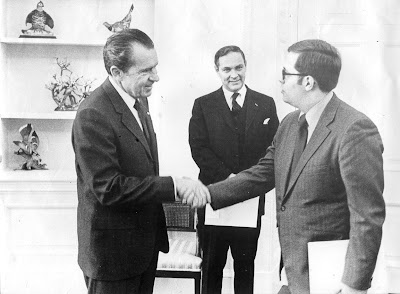
In February 1971, I met with then President Richard Nixon to discuss a report co-authored by me on the Progress of Vietnamization.


This was the name given to a program, begun by this President, that provided American styled basic military training to young Vietnamese men who became members of the Army of the Republic of Vietnam (ARVN). Once trained, new ARVN units would replace American units that would then be brought home.  In a sense it is similar to the training provided by U.S. forces right now in Iraq and Afghanistan.

Yes, that is a picture of the author (above) with the President and then Assistant National Security Advisor, General Alexander M. Haig, Jr., in the Oval Office.  

During the meeting, the President addressed criticism he had received over prolonging the war. He said that he was trying to extract U.S. troops in a way that would give the South Vietnamese a better chance to defend themselves and made the point that he was not a warmonger. The President then turned and asked Press Secretary Ron Ziegler how many men were killed that week.  Ziegler said 32.  Mr. Nixon then said, "It's always a number.  When I came here the number was in the hundreds, always a number."  "Yet, I'm a politician," the President continued, "and if there is one thing I know is that they are not numbers, they are men."

The President went on to say that he had a theory that by the time a man is 18, 19, 20, he has touched the lives of at least 2,000 people --- his elementary and high school classmates, cub scouts, boy scouts, little league, family, friends, neighbors, church members, they all add up.  So while 32 men may have died in Vietnam that week, the President said, 64,000 Americans have been personally and painfully impacted by the war.

Ever since that meeting I have called this observation, the Nixon factor of how war can impact a nation.  When you apply it to the War in Vietnam with 211,501 casualties (58,198 dead and 153,303 wounded), the Nixon factor indicates that 423,002,000 Americans were personally impacted, some more than once.  Since that number exceeded the population at that time, it is fair to say that most every citizen was personally touched by the war.

When you apply the Nixon factor to the War in Iraq and Afghanistan with 38,960 casualties (4,953 dead and 34,007 wounded as of 4/24/2009), the results find that some 77,920,000 Americans have been personally impacted.

Something to ponder when those in power consider sending young American men and women in harms way.


Thursday, April 23, 2009

The Stress of It All is Becoming Dangerous

by Bill Seebeck

It seems that not a day goes by during these most difficult financial times when we don't hear a story about people "losing it".  Just this week, a young man apparently took his life.  He was the acting chief financial officer of Freddie Mac whose stated mission is to help stabilize residential mortgage markets in the United States.  The Treasury Department took over the company last September.  He was only 41.

That story was followed up by another in which it was reported that a lawyer mother ordered her two daughters out of the car because they were yelling too much and wouldn't quiet down. I checked up on the mother and found that she is a skilled senior attorney whose specialty is law that governs banking and other lending institutions with particular emphasis on the very issues being faced by, we the people, and our Treasury Department.

No matter what else was going on in the lives of these two individuals, I recognized in them, one of the real threats to the health and welfare of the American people.

STRESS.

Every day, in addition to whatever we've had to previously bear, we are now faced with losing our jobs, keeping our homes, feeding ourselves and our children not to mention the loss of dreams of retirement, college education and just a plain better life.  This folks results in stress and it has a profound impact on us.

According to a 1996 article in Psychology Today, "When stresses become routine, the constant biochemical pounding takes its toll on the body; the system starts to wear out at an accelerated rate. By responding to the stress of everyday life with the same surge of biochemicals released during major threats, the body is slowly killing itself. The biochemical onslaught chips away at the immune system, opening the way to cancer, infection, and disease. Hormones unleashed by stress eat at the digestive tract and lungs, promoting ulcers and asthma. Or they may weaken the heart, leading to strokes and heart disease." "Chronic stress is like slow poison," [Jean] King [Ph.D. of the University of Massachusetts Medical School] observes. "It is a fact of modern life that even people who are not sensitized to stress are adversely affected by everything that can go wrong in the day."

This is another reason why I have been so worried about the war in Iraq and Afghanistan.   I am not concerned about the professionalism of our armed forces but I am concerned about the constant stress that four or five years of combat, four, five, six 12 and 15 month deployments have had on our service people and their families.  And don't think that bravado will overcome it, it will not.  Examine the increasing suicide rate among the military and you will find that we have a problem that can't be swept under a rug.

Watch the way people drive these days, listen to the concerns we share with one another, we as a nation are worried and stressed. Our institutions have failed us and our social contract has been broken.  Now we can fix it, but there must be more relief given directly to the people in order that the stress of it all doesn't endanger us in ways we have never yet experienced as a society.

What do you think?


Saturday, March 21, 2009

Mr. President: Train Afghan Police Forces in U.S.

This morning, Reuters reported out of Brussels, Belgium that President Obama plans to significantly increase the size of the Afghan police force.  The story was attributed to U.S. special representative for Afghanistan and Pakistan Richard Holbrooke.

The usual plan was described in the article which was to send over hundreds of U.S. specialists, etc., etc. to train the candidates in country.

I say, if there are police or army personnel to be trained let's bring them here to the U.S. for their training.  It is a safer, much more efficient method and we can rotate classes at a faster rate.  It would also give these individuals a picture of the U.S. and its people.  We would not have to deal with insurgent attacks and many other issues related to training personnel in country.

In addition, for a period of time, it will create jobs in areas once served by U.S. military training facilities that can be reopened and utilized.  Good for the Afghans, good for the U.S.

Mr. President, this is change for the better.  We should have done it with the Iraqi army, let's do it with the Afghans.

Please sir.


Copyright 2009 WBSeebeck

Monday, March 16, 2009

No Russian Presence in Cuba or Venezuela!

Let there be no mistake, if we don't stand on our heels and growl as Teddy Roosevelt's bear did back in the early 20th century, the Russians will establish air and later naval bases in Cuba and Venezuela.

The Russian government has already held joint naval operations in the Caribbean with these nations and just announced their intention to stage bombers in these two countries.  This is totally unacceptable to the United States.

We trust that President Obama will stand and publicly state that the presence of Russian offensive weapons in our hemisphere is unacceptable and a threat to the national security of the United States.

Those of us who lived through the Cuban missile crisis and other similar encounters with the Soviet Union and now Putin's Russia know that their intentions are not honorable.

Copyright 2009 WBSeebeck

Thursday, March 5, 2009

Beware Oil Prices! Speculation May Be in Play Again!

Today, on CNBC, an analyst claimed that the oil market had "bottomed out" and that there was an increase in demand.  As a result, he believed that oil might quickly rise to $60.00 per barrel. If this CNBC guest analyst is to be believed, we are about to enter another period of dramatic increases in oil prices. If you read my February 11th article on oil, you would know two things: One, such increases are based on speculation rather than reality or demand and second, that any price over $50.00 per barrel will cause untold hardship on the American consumer and economy at a time when we can least handle it. 

Copyright 2009 WBSeebeck
 
Custom Search